
The short answer
Your EVAP system keeps gasoline vapor from escaping into the air. It traps the fumes from your fuel tank and feeds them to the engine to be burned. When it leaks or a valve sticks, the check engine light comes on.
An EVAP fault alone is usually safe to drive with for a short time. It rarely changes how the engine runs. Three reasons not to ignore it:
- The check engine light is already on, so it can't warn you about the next problem.
- While North Carolina still tests emissions in your county, a lit check engine light fails that inspection.
- A strong raw fuel smell or wet fuel under the car is different. That is a fuel leak. Don't drive it.
What the EVAP system does
Gasoline evaporates all the time, even with the car parked. EVAP stands for evaporative emission control. It is a sealed system that catches that vapor instead of letting it out of the tank.
It works in two steps:
- Store. Vapor from the tank flows into a canister filled with activated charcoal. The charcoal holds fuel vapor the way a sponge holds water.
- Burn. Once the engine is running and warmed up, the car's computer opens a valve. Engine vacuum pulls the stored vapor into the intake, and the engine burns it with the rest of the fuel.
You never feel it working. You only hear about it when the car's self-test finds a leak or a valve that isn't doing its job.
The parts, from gas cap to engine
- Gas cap or capless filler
- Where it is: Fuel door.
- What it does: Seals the top of the system.
- How it fails: Worn seal, cap left loose, or dirt holding a capless flap open.
- Filler neck
- Where it is: Between the fuel door and the tank.
- What it does: Carries fuel down to the tank.
- How it fails: Rusts through, or the hose at the tank cracks.
- Fuel tank pressure sensor
- Where it is: On the tank or a vapor line.
- What it does: Tells the computer the pressure inside the tank.
- How it fails: Reads wrong, so the self-test fails or never runs.
- Charcoal canister
- Where it is: Usually under the rear of the car, near the tank.
- What it does: Stores fuel vapor.
- How it fails: Cracks, or gets soaked with liquid fuel.
- Vent valve
- Where it is: On or near the canister.
- What it does: Normally open to let air in and out. Closes to seal the system for a leak test.
- How it fails: Sticks open or shut, or clogs with dust.
- Purge valve
- Where it is: Under the hood, on or near the intake.
- What it does: Normally closed. Opens so the engine can draw in stored vapor.
- How it fails: Sticks open, or stops opening.
- Hoses and lines
- Where it is: Running the length of the car.
- What it does: Connect all of it.
- How it fails: Crack, rub through, or pop off.
Some cars add a small leak detection pump that pressurizes the system for the self-test.
How your car tests itself
Your car checks its own EVAP system for leaks. It closes the vent valve to seal everything, puts the system under a light vacuum or pressure, and watches the tank pressure sensor. If the reading holds, the system is sealed. If it bleeds off, there is a leak, and how fast it drops tells the computer how big.
The test is sensitive. The smallest leak code is for an opening about 0.020 inch across, the size of a pinhole.
The test only runs when conditions are right. That usually means a cold start and a tank that is neither nearly empty nor full, and the details vary by make. Many cars run it after you shut the engine off. Two things follow:
- The light can come on days after the problem started.
- After a fix, the light can take several days of normal driving to go out. The car has to pass its own test on a few separate trips first.
Signs of an EVAP problem
- Check engine light with no change in how the car drives. The most common sign, and often the only one.
- A "check fuel cap" message on the dash.
- Fuel smell around the car, mostly near the rear or after it sits in a closed garage.
- Hard start or rough idle right after filling up. This points toward a purge valve stuck open, which lets fuel vapor flood the engine.
- The pump nozzle keeps clicking off while you fuel. This points toward a blocked vent valve or canister. Air can't get out of the tank as the fuel goes in.
What we replace most
In our work, these are the EVAP failures that come up again and again:
- Purge valves stuck open, stuck closed, or slow to respond.
- Vent valves stuck or clogged.
- Charcoal canisters that break down inside. Loose charcoal travels and plugs the EVAP lines.
- Gas caps and filler necks that no longer seal.
- Rodent damage. Chewed EVAP hoses and lines are a common find. It happens most on cars parked on gravel, in fields, under trees or beside hedges.
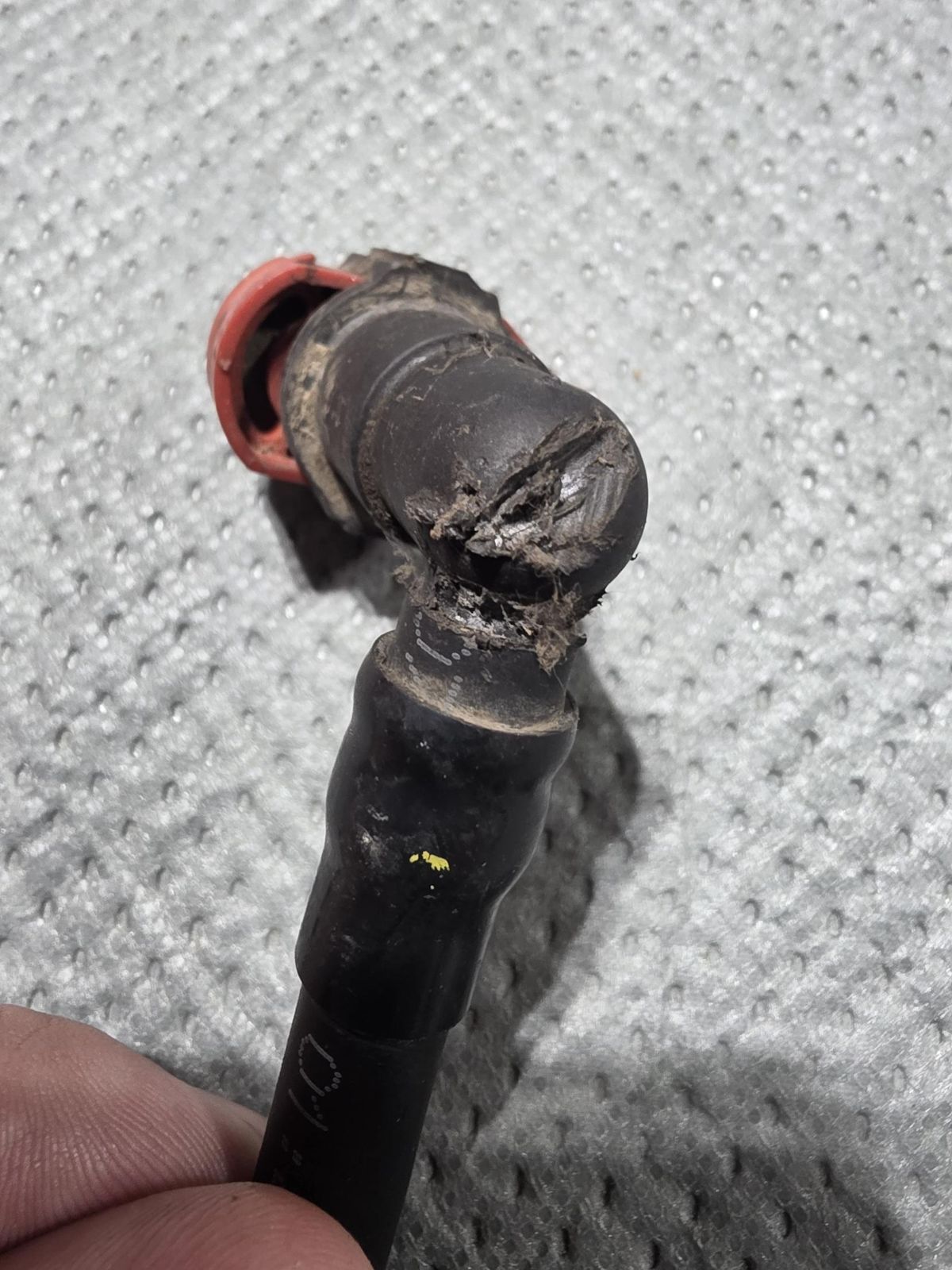
From our jobs:
- Chevrolet Silverado, gas pump kept clicking off. The canister had broken down, and charcoal was found inside the EVAP lines, blocking the vent path.
- 2017 Ford F-150, several EVAP codes at once. Rodents had chewed holes in the plastic hoses that route the vent side of the system.
Common EVAP codes and what they point to
A code tells you which test failed. It does not tell you which part to buy. That is why a free code read so often ends in a new gas cap that fixes nothing.
- P0455
- What the car is reporting: Large leak.
- Where a technician looks first: Loose or missing gas cap, a hose that came off, vent valve stuck open.
- P0457
- What the car is reporting: Leak, fuel cap loose or off.
- Where a technician looks first: Gas cap and the filler neck seal.
- P0442
- What the car is reporting: Small leak.
- Where a technician looks first: Cap seal, cracked hose, canister, filler neck.
- P0456
- What the car is reporting: Very small leak.
- Where a technician looks first: The same places as P0442. This is the one that needs a smoke machine.
- P0496
- What the car is reporting: Vapor flowing when it shouldn't be.
- Where a technician looks first: Purge valve stuck open.
- P0441
- What the car is reporting: Purge flow not what the computer expected.
- Where a technician looks first: Purge valve, or a blocked or disconnected purge line.
- P0446 and P0449
- What the car is reporting: Vent valve problem.
- Where a technician looks first: Vent valve, its wiring, a clogged vent.
- P0451 to P0453
- What the car is reporting: Tank pressure sensor reading problem.
- Where a technician looks first: The sensor and its wiring.
- P0440
- What the car is reporting: General EVAP fault.
- Where a technician looks first: Start at the top with a full system test.
A purge valve that is stuck, slow or leaking through can also set a leak code, not just a purge code. The same code can point to different parts on a GM, a Ford or a Chrysler, Dodge, Jeep or Ram, because each maker builds and tests the system its own way, and many add their own EVAP codes on top of these.
What you can check yourself
Three things cost nothing and are worth doing before you pay anyone:
- Check the gas cap. Make sure it's there and the rubber seal isn't cracked or flattened. Tighten it until it clicks. On a capless filler, look for dirt holding the flap open.
- Stop topping off. When the pump clicks off, you're done. Squeezing in more can push liquid fuel into the charcoal canister and ruin it.
- Give it a few days. If a loose cap was the cause, the light should go out on its own after several days of normal driving.
If the light is still on after a week, or it went out and came back, the leak is somewhere else. From here, guessing at parts usually costs more than testing.
How the leak gets found: smoke testing
A pinhole leak somewhere along a system that runs the length of the car can't be found by looking. It gets found with a smoke machine.
- Scan and read the data. The codes, the conditions when they set, and what the tank pressure sensor is reading.
- Seal the system. A scan tool commands the vent valve closed, the same way the car does for its own test.
- Fill it with smoke. The machine pushes a visible vapor into the EVAP system at very low pressure, well under 1 psi. Shop air is never used. That much pressure can damage the tank and sensors.
- Find where it comes out. Smoke shows at the leak: a cracked hose, a canister seam, the filler neck, the cap seal. Many machines add a dye that glows under UV light, for the small ones.
- Test the valves. The purge and vent valves are commanded open and closed to confirm they seal and flow when they should.
Then you get a written estimate that names the part that failed, before any repair starts.
The diagnosis with a smoke test usually takes about an hour on site. Whether the repair can be done where the car is parked depends on how easy the fuel tank is to reach. Parts on or near the tank sometimes need a hoist, and we tell you before we book the repair.
EVAP and North Carolina inspection
North Carolina requires a yearly safety inspection in every county. As this was written in November 2026, 19 counties also require an emissions inspection, done by reading the car's computer. Around Charlotte and Lake Norman that covers Mecklenburg, Lincoln, Gaston, Iredell, Cabarrus, Rowan and Union. It applies to gasoline cars and light trucks from the 20 most recent model years.
Where that inspection applies, EVAP matters in two ways:
- An EVAP code turns on the check engine light, and a lit check engine light fails the emissions inspection.
- Clearing the code just before the inspection doesn't get around it. Clearing codes also resets the car's self-tests, and the inspection checks whether they have run. The EVAP test is often the slowest one to finish.
This is set to change. State laws passed in 2023 and 2026 end the emissions inspection in all 19 counties, Mecklenburg included. They take effect only after the EPA gives final approval. The EPA proposed approval on May 8, 2026. The state's air quality page said the EPA was still reviewing public comments when this was written. The yearly safety inspection stays.
Once it ends, an EVAP light will no longer hold up your registration. The light will still be on, and it still can't tell you about the next problem.
Getting it fixed
EVAP repairs run from a gas cap to a canister, so the right repair starts with finding the leak.
- Find the cause first. The right part gets replaced, not a guess.
- Written estimate first. You see what failed before any work starts.
- Your choice of part. Options are ranked by quality and warranty term, from the best aftermarket and OEM parts.
- Warranty: 12 months or 12,000 miles on our labor, whichever comes first. Parts carry the manufacturer's warranty, and when we supply the part we handle that claim for you.
- Where: where the car is parked, in Charlotte and the Lake Norman area. Like every repair we list, not every car can be done in a driveway. If we quoted your repair and can't reach the part when we arrive, your deposit is refunded.
Get it fixed where it's parked
LemonProof Auto diagnoses and repairs EVAP systems in Charlotte and the Lake Norman area. We come to the car, find the leak, and show you the estimate before we fix anything.
Sources
Updated November 26, 2026.